
Self-check
Find my Kettei
Think of one decision your organisation approved this year. Write it in one sentence, with the date it was approved.
Print the card or read it on screen. This page does not collect your answers.
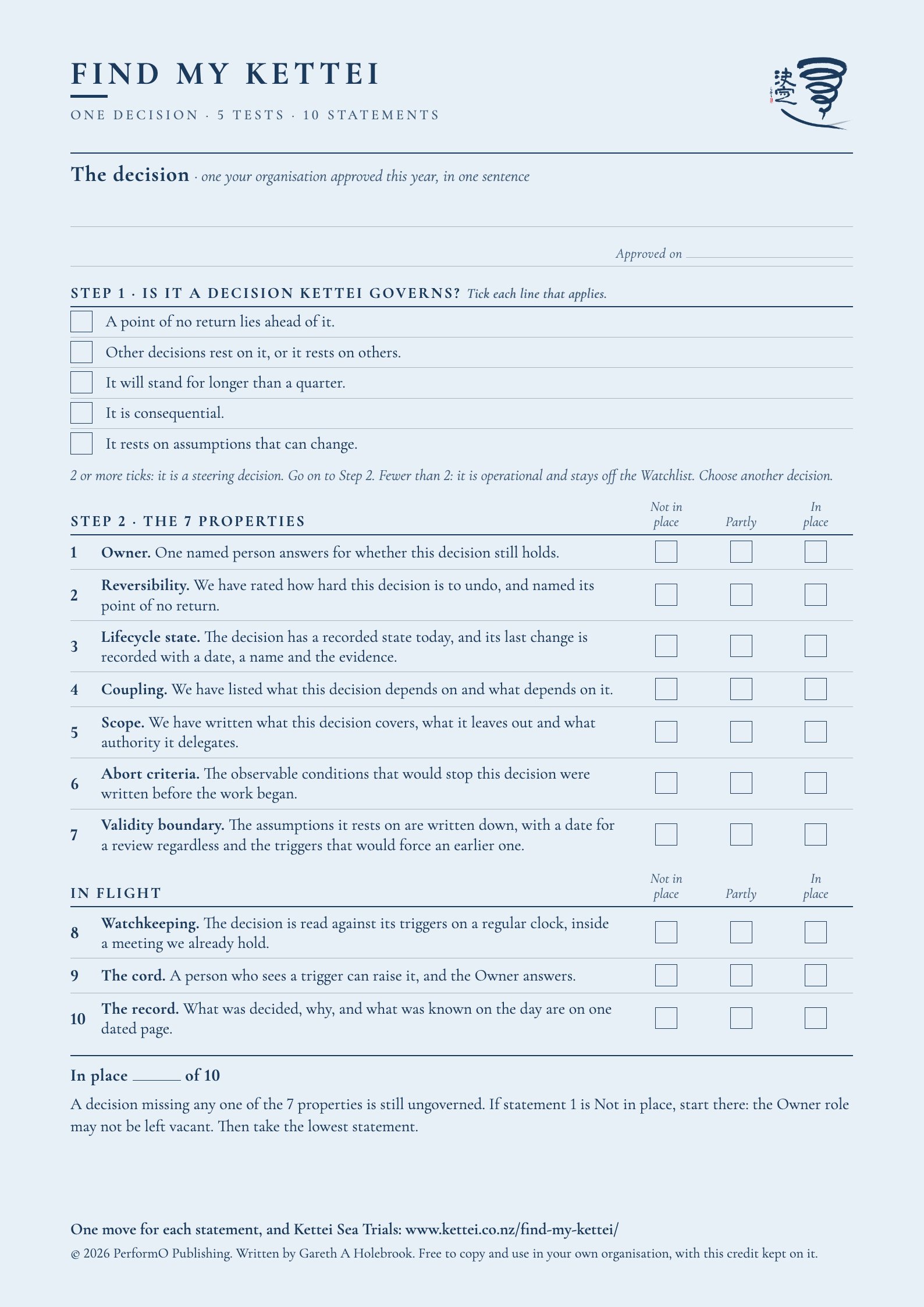
Step 1. Is it a decision Kettei governs?
Tick each line that applies.
- A point of no return lies ahead of it.
- Other decisions rest on it, or it rests on others.
- It will stand for longer than a quarter.
- It is consequential.
- It rests on assumptions that can change.
2 or more ticks: it is a steering decision. Go on to Step 2. Fewer than 2: it is operational and stays off the Watchlist. Choose another decision.
Step 2. The 7 properties
Each statement: Not in place, Partly or In place. Under each is one move for when it is not yet in place.
- 1Owner. One named person answers for whether this decision still holds.Not yet in place? Name one person. A committee or an open role does not count. The Decision Owner
- 2Reversibility. We have rated how hard this decision is to undo, and named its point of no return.Not yet in place? Write what reversing it would cost against what delay would cost, and mark its point of no return. The 7 properties
- 3Lifecycle state. The decision has a recorded state today, and its last change is recorded with a date, a name and the evidence.Not yet in place? Record its state today (Proposed, Active, Suspended, Superseded, Revoked or Closed) with the date and who set it. Lifecycle states
- 4Coupling. We have listed what this decision depends on and what depends on it.Not yet in place? List the decisions upstream of it and the decisions downstream. Coupling
- 5Scope. We have written what this decision covers, what it leaves out and what authority it delegates.Not yet in place? Write 3 lines: what it covers, what it leaves out, what authority it delegates. The 7 properties
- 6Abort criteria. The observable conditions that would stop this decision were written before the work began.Not yet in place? Write the observable conditions under which the Owner would stop it. Abort criteria
- 7Validity boundary. The assumptions it rests on are written down, with a date for a review regardless and the triggers that would force an earlier one.Not yet in place? Write the assumptions, a review date and the triggers. Validity boundary
In flight
- 8Watchkeeping. The decision is read against its triggers on a regular clock, inside a meeting we already hold.Not yet in place? Put the Watchcard into a steering meeting already held. Owners speak on exception; about 15 minutes. Watchkeeping
- 9The cord. A person who sees a trigger can raise it, and the Owner answers.Not yet in place? Tell the programme who the Owner is and how to raise a trigger. Watchkeeping
- 10The record. What was decided, why, and what was known on the day are on one dated page.Not yet in place? Fill in a Kettei Card from what was known on the day it was approved. The Kettei Card
Reading the result
Count the statements in place, out of 10. A decision missing any one of the 7 properties is still ungoverned. If statement 1 is Not in place, start there, because the Owner role may not be left vacant. Then take the lowest statement.
Kettei Sea Trials
Kettei Sea Trials puts these 10 statements in place for an organisation’s consequential decisions, over a 12-week pilot that follows the Kettei Workshop.